What Are Business Drivers? How To Identify and Use Yours
If someone asked you right now to list the drivers of your business, what would you say? You might pause, not because you don't know your business, but because "business drivers" is one of those terms that means everything and nothing until you sit down to define it for your own situation.
This guide breaks it down: what business drivers actually are, how to identify yours, and why understanding them is one of the highest-leverage moves you can make as a business leader.
What Are Business Drivers?
Business drivers are the actions, activities, and systems that "drive", or have a major impact on, the success and results of your company. They are the variables that, when moved, move everything else.
Some drivers are obvious. Others are counterintuitive. The list looks different for a professional services firm than it does for a product company or a manufacturer. Here are common examples:
- Sales volume
- Customer satisfaction
- Employee retention
- Product quality
- On-time delivery
- New product development
- Innovation cadence
- Operational efficiency
- Customer lifetime value
- Pricing power
The challenge isn't learning the concept, it's applying it. Most business owners can rattle off a list of things that matter to their company. Far fewer have done the disciplined work of ranking them, measuring them, and connecting them to outcomes.
Determining Your Business Drivers
Before you can identify your drivers, you need a framework for thinking about measurement. That starts with understanding the difference between leading and lagging indicators.
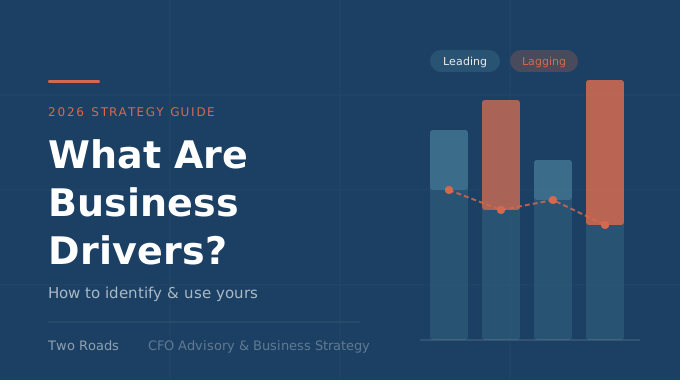
Leading vs. Lagging Indicators
Lagging indicators are outcome-based metrics that tell you whether you achieved your desired result. They're the scoreboard — important, but they can't help you course-correct in real time. Example: Your Q2 sales total was $1.2M — up 8% year-over-year.
Leading indicators are predictive metrics that tell you whether you're on track to reach your desired result. They're the GPS pointing you toward (or away from) the outcome before it happens. Example: New qualified leads this month: 42. Pipeline coverage ratio: 3.1x.
Both types matter, but leading indicators are more powerful for day-to-day decisions. They give you the ability to adjust your approach before the final result is locked in.
In 2026, companies with strong data infrastructure have a significant advantage here as they can track leading indicators in near-real time rather than waiting for monthly close or quarterly reviews. But even without sophisticated tooling, identifying the right leading indicators for your business is a high-value exercise.
Identifying the Drivers That Matter for Your Company
Once you understand the distinction between leading and lagging indicators, the next step is a structured brainstorm to surface your most important drivers. Start broad, then narrow.
Helpful Questions to Guide the Process
- What are the specific business goals you're trying to achieve in the next 12–24 months?
- Which leading indicators will tell you whether you're on track to hit those goals?
- Which lagging indicators will confirm, or refute, that you've achieved them?
- What processes or activities are most directly affected by each of these drivers?
- Which drivers, if ignored, would cause the biggest problems for your business?
- Are there drivers you're not currently measuring that you suspect are critical?
Don't try to identify every driver at once. A focused list of five to eight well-chosen drivers, ones you actually track and act on, is far more useful than a sprawling list of twenty that sits in a slide deck.
Why Identifying Your Business Drivers Matters
Focus. Identifies where to direct attention and resources for maximum impact.
Better decisions. Replaces gut-feel with data-backed choices that are easier to defend and refine.
Clarity. Gives leaders and teams a shared vocabulary for what success looks like.
Early warning. Leading indicators surface problems weeks or months before they show up in financials.
The businesses that outperform their peers typically aren't doing dramatically different things, they're doing the same things with more discipline and more clarity about what's actually moving the needle. Identifying your drivers is step one of that discipline.
How a Fractional CFO Helps With Business Drivers
Most business owners are excellent at running their business. A fractional CFO earns their place at the table by building the measurement systems and financial frameworks needed to understand why it's running the way it is.
A great CFO doesn't just report on what happened, they help you identify which drivers matter most for your specific business, build the infrastructure to track them, and translate that data into tactical and strategic decisions.
At Two Roads, that's exactly what our CFO advisory work looks like in practice: helping founders and executives connect the day-to-day activities of their business to the outcomes they're trying to create.
If you're ready to identify what's driving your business, contact Two Roads today to get started, or explore our CFO advisory services to learn more about how we can help.